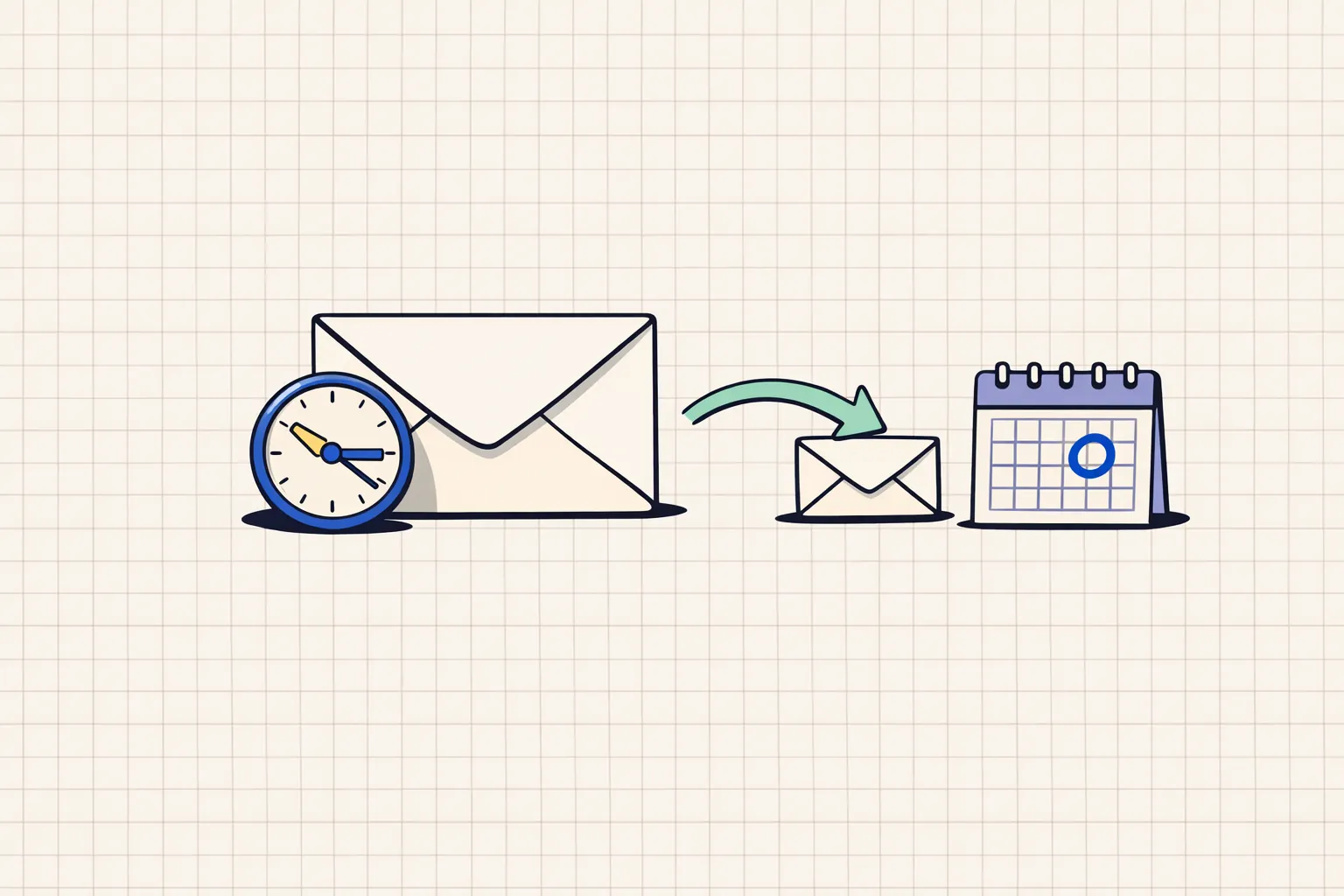
A good follow-up email is short, names the exact thing you are waiting for, and makes it easy for the other person to answer. Send it after a sensible wait: within 24 hours for a thank-you after an interview, about a week later if you have heard nothing, and never before a deadline the other person gave you. Two follow-ups without a reply is usually the point to stop writing and move on.
Most follow-ups fail for a simple reason. They ask the reader to remember the context, find the earlier message and work out what is wanted. The fix is to do that work for them, in two or three sentences.
What a good follow-up email does
In practice, a follow-up that works does four things. It reminds the reader of the earlier contact in one line, with a date or a detail they will recognize. It states what you need, as a question they can answer. It adds something new if you have it, such as a file, a correction or a deadline that changed. And it ends without pressure, so replying feels easy.
What it leaves out matters as much. No apology for writing. No paragraph about how busy they must be. No "I just wanted to check in", which tells the reader nothing about why you are writing. HubSpot's guide to sales follow-ups says such repeated phrases rarely catch the recipient's attention, and its author never recommends that salespeople send "just checking in" emails.
Length follows from this. Most follow-ups need 50 to 125 words. If yours runs past 150, you are probably repeating the first email instead of pointing to it.
When to send it
Timing depends on the situation and on whether the other person told you when to expect an answer. If they did, wait until that date has passed. The career services office at Hardin-Simmons University, republishing guidance from The Muse, warns that following up before a stated time frame has passed can seem impatient.
If no date was given, these waits are a reasonable default:
| Situation | First follow-up | Second follow-up |
|---|---|---|
| Thank-you after an interview | within 24 hours | not needed |
| No news after an interview | about 1 week after the interview | about 1 week after the first |
| Job application, no interview yet | 1 to 2 weeks after applying | about 2 weeks later |
| Proposal or quote sent to a client | 3 to 5 business days | about 1 week later |
| Meeting request or introduction | about 1 week | 1 to 2 weeks later |
| Colleague owes a deliverable | the day after the agreed deadline | 2 to 3 business days later |
| Urgent document or signature | within 48 hours | next business day, then call |
The interview rows follow the University of Kentucky's Pigman Career & Co-op Center, which republished advice from The Muse: send the thank-you within 24 hours, check in if you hear nothing within a week, and send a second message if another week passes with no response. HubSpot's guide uses similar windows for business email: 24 hours for a thank-you after a meeting or interview, 48 hours when the reason is urgent, and one to two weeks for a meeting request or a job offer you have not heard back about.
The job application, client and colleague rows come from working practice. No source sets them, so adjust them to how fast the person normally answers. A manager who replies to everything within an hour has a different clock from a client who answers on Thursdays.
Grammar checker
Checks text written in English, German, Spanish, French, Italian, Dutch, Portuguese, Polish, Russian, and Arabic.
Run the tool and your result shows up here.
Follow-up email after an interview
There are two different emails here, and people often mix them up. The thank-you goes out within a day and asks for nothing. The follow-up goes out a week or so later, when you have not heard back, and asks one question: where does the process stand?
The thank-you email
Subject: Thank you, Account Coordinator interview on Tuesday Hi Ms. Patel, Thank you for talking with me on Tuesday about the Account Coordinator role. I enjoyed hearing how your team took over the two retail clients last spring, and it made me more interested in the job. If it helps, I have attached the campaign report I mentioned. Please let me know if you need anything else from me. Best regards, Jordan Lee
Why it works, line by line. The subject names the role and the day, so it is easy to find later. The first sentence thanks them for something specific, which proves you listened. The attachment adds value and does not repeat your resume. There is no question about a decision, because a day after the interview there is none to give.
The follow-up when you have heard nothing
Subject: Following up on the Account Coordinator interview Hi Ms. Patel, I interviewed for the Account Coordinator role on October 14 and wanted to ask whether there is an update on the timeline. I am still very interested in the position. If it would help your decision, I am happy to send references or a writing sample. Best regards, Jordan Lee
The date in the first line saves the reader a search. The question is direct and easy to answer, even with "not yet, we expect to decide next week". The offer in the second paragraph gives them a reason to reply that goes beyond a status report.
If they said they would contact you
Wait until the date they gave has passed, then send the follow-up anyway. A date in an interview is an estimate, and hiring often runs late. A polite message one or two business days after that date is normal and expected. Refer to what they said: "You mentioned you hoped to decide by the end of last week, so I wanted to ask whether there is any news."
The second follow-up
If a week goes by after the first follow-up, one more message is fine. Keep it even shorter, and make it easy to close the loop:
Hi Ms. Patel, I wanted to check once more on the Account Coordinator role. If the position has been filled, I would be grateful for a quick note so I can plan my search. Thank you again for your time.
The Pigman Career & Co-op Center article calls a second message reasonable and warns that sending more than two without a response can be excessive. After that, move on.
Following up on an application before any interview
If you applied and heard nothing, wait one to two weeks, then send a short note to the recruiter or hiring manager.
Subject: Application for the Account Coordinator role, sent October 3 Hi Mr. Okafor, I applied for the Account Coordinator role on October 3 and wanted to confirm that my application arrived. My last two years managing retail client accounts match the job description closely, and I would welcome the chance to talk. Is there anything else you need from me? Best regards, Jordan Lee
Keep it to the role, the date and one line on fit. A full second cover letter is too much.
Following up with a client who went quiet
Clients go quiet for ordinary reasons: the budget owner is on vacation, or your proposal sits in a folder with 40 others. Your follow-up should make the next step smaller. Repeating the pitch in other words rarely helps, because the client already read it once and did not act.
Subject: Website redesign quote from October 20, two options Hi Daniel, I sent over the quote for the website redesign on October 20. In case the full scope is too much for this quarter, I can split it into two phases, with the product pages first at about half the cost. Would a 15-minute call on Thursday or Friday help you decide which works better? Thanks, Priya
The subject line names the project and the date, and it promises something new ("two options"), which gives a reason to open it. The body offers a smaller version, which lowers the cost of saying yes. And the question at the end is concrete, with two days to choose from. "Let me know your thoughts" is much harder to answer.
If this email and one more after it get no answer, send a short closing email a week or two later:
Hi Daniel, I have not heard back about the redesign, so I will assume the timing is not right and close the file on my side. If things change, I am happy to pick it up again.
A message like this can still get a reply, because it asks for nothing and lets the client say "actually, we still want it" without embarrassment. If it does not, you have ended the thread politely and can stop thinking about it.
Following up with a colleague or manager
Internal follow-ups have a different risk. You will work with this person next week too, so the tone has to stay friendly even when you are annoyed. Specific is better than polite padding.
Before:
Hi Sam, just checking in on the numbers. No rush, whenever you get a chance. Thanks so much and sorry to bother you.
After:
Hi Sam, could you send the Q3 regional sales numbers by Wednesday noon? I need them for the board slides on Thursday. If the West figures are not final yet, the East ones would already help.
The first version apologizes three times and never says what is needed or by when. "No rush" also invites the reader to put it last, which is the opposite of what you want. The second version gives the deadline, the reason for it and a fallback.
With a manager, the same structure works, but you are usually asking for a decision: "Can you confirm by Friday whether I should book the trainer for November? The venue holds the date until Monday." If your manager tends to miss email, a one-line chat message pointing to the email is fine.
Subject lines that work, and three that don't
A follow-up subject line has to do two things: tell the reader what the email is about and help them find the thread later. If you reply in the same thread, the original subject stays, which is often the best choice, because it keeps the history in one place. If you start a new email, write a subject that would make sense to someone who forgot the first one.
Subject lines that tend to work name the topic and the reason:
- "Following up on the Account Coordinator interview"
- "Q3 sales numbers needed by Wednesday noon"
- "Website redesign quote from October 20, two options"
- "Signed contract still missing page 4"
Three that don't:
- "Just checking in." It names nothing, so it looks like it can wait.
- "Quick question." HubSpot's guide reports that in its own 2014 study of 6.4 million emails sent with its sales tool, messages with "Quick" in the subject line were opened 17 percent less often than those without it.
- "Following up" with nothing after it. Fine inside a thread, useless as a new subject line, because every follow-up in their inbox says the same.
The same HubSpot guide suggests writing the subject line after the body, so it describes the email you actually wrote.
How many times to follow up, and when to stop
For job applications and interviews, the career office guidance above gives a clear ceiling: a thank-you, then up to two follow-ups spaced about a week apart.
For clients and sales leads, two or three follow-ups over two to four weeks is a common pattern, ending with a polite closing email like the one above. Each one should bring something new, such as a smaller option, a relevant result or a changed deadline. If you have nothing new to say, you probably do not need to send the next one.
Inside your own company, there is no fixed number, because the work still has to happen. If two emails get no answer, change the channel. Walk over, call, or raise it in the next meeting. If the delay is now blocking your own deadline, tell your manager in a neutral way: "I am still waiting for the Q3 numbers from Sam, which I need for Thursday. Is there someone else who can send them?"
Stop when the answer is clear, even if it is no. Also stop when silence has lasted past the point where any answer would still be useful to you. A follow-up sent two months after an interview rarely changes the result.
A final read before you hit send
A follow-up is short, so every mistake stands out. Before sending, check four things.
First, the names and dates. A wrong date in "I sent the quote on October 20" undermines the whole message. A misspelled name is worse.
Second, the attachment. If you write "attached", attach it. A follow-up that needs its own follow-up because the file is missing looks careless.
Third, the tone. Read it as the recipient would, on a busy afternoon. Does it sound like a question or like a complaint? Phrases such as "as I said in my last email" or "per my previous email" often read as irritated, even when you did not mean them that way.
Fourth, the spelling and grammar. Our grammar checker flags spelling, grammar and punctuation errors. It is free and unlimited, so you can run every draft through it. If a sentence still sounds stiff or pushy, the paraphraser can suggest other wordings. The free version takes 125 words once a day in its standard and fluency modes, which covers most follow-ups.
If you are trying to keep the message tight, paste it into the word counter and check the longest sentence. Anything over about 30 words in a follow-up is a sentence the reader will skim.
Then read it aloud once. If you would not say it to the person's face, change it. And if you are writing while annoyed, save it as a draft and send it an hour later. An hour rarely matters to the other person, and the calmer version is easier to answer.
Keep going with your own text
Free plan
0 USD
Check your text without a card. You get the same daily free use here as on the tool pages.
Check grammarWord packs
Buy extra rewriting words only when you need them.
- AI detectorfrom 5.99 USD
- Humanizerfrom 9.99 USD
- Paraphraserfrom 9.99 USD
- Summarizerfrom 6.99 USD
Questions about this article
How long should I wait to send a follow-up email?
About a week for most situations where no date was promised. After an interview, send a thank-you within 24 hours and a status follow-up after about a week. If the other person gave you a date, wait until it has passed.
What should the subject line of a follow-up email say?
The topic and, ideally, the reason. "Following up on the Account Coordinator interview" or "Quote from October 20, two options" work. If you reply in the original thread, keep the original subject so the history stays together.
How do I follow up without sounding pushy?
Be specific and brief. Name what you are waiting for, ask one clear question and give the reader an easy way to answer. Skip the apologies and the "just checking in", which make you sound unsure of your own request.
How many follow-up emails is too many?
For job applications, more than two follow-ups without a reply is usually too many. For clients, two or three spread over a few weeks, ending with a polite closing note, is a sensible limit.
What do I write if I already followed up once?
Keep the second follow-up shorter than the first. Refer to your earlier email, ask once more, and make it easy to close the loop, for example by asking for a short note if the position has been filled or the project is on hold.
Is it better to call or email?
Email first, because it gives the other person time to answer and leaves a record. A call makes sense when something is urgent, when two emails have gone unanswered inside your own company, or when the other person has said they prefer the phone.
How do I follow up on a job application with no interview yet?
Wait one to two weeks after applying, then email the recruiter or hiring manager if you can find the address. Name the role and the date you applied, add one line on why you fit, and ask whether they need anything else.
Can I follow up on a Friday?
Yes. The day matters less than the content. If the matter is time-sensitive, a Friday email lets the reader see it before the weekend. If it is not, sending on Monday or Tuesday morning is also fine. Pick the time the person is most likely to be at their desk.
How long should a follow-up email be?
Usually 50 to 125 words. It should fit on a phone screen without scrolling. If it is longer, you are probably repeating the first email instead of pointing to it.
What if I made a mistake in the first email?
Correct it in a short follow-up as soon as you notice. Say what was wrong and give the right information in one or two sentences, for example the correct date or the missing attachment. One brief apology is enough.